The July nonfarm payrolls report arrives with the labor market sending conflicting signals just two days ahead of the release data.
ADP reported that private job growth was the weakest in months and well below expectations. Yet wage growth remained firm, suggesting companies are slowing hiring without aggressively cutting workers. At the same time, both S&P Global's Services purchasing managers’ index (PMI) and the Institute for Supply Management’s (ISM) Services survey pointed to a sector that continues to expand, with business activity, demand, and hiring all holding up better than the payroll data alone would suggest.
The result is a labor market that appears to be cooling, but not cracking.
ADP: Hiring Slows Sharply, But Wage Pressures Persist
The headline from ADP was undeniably soft.
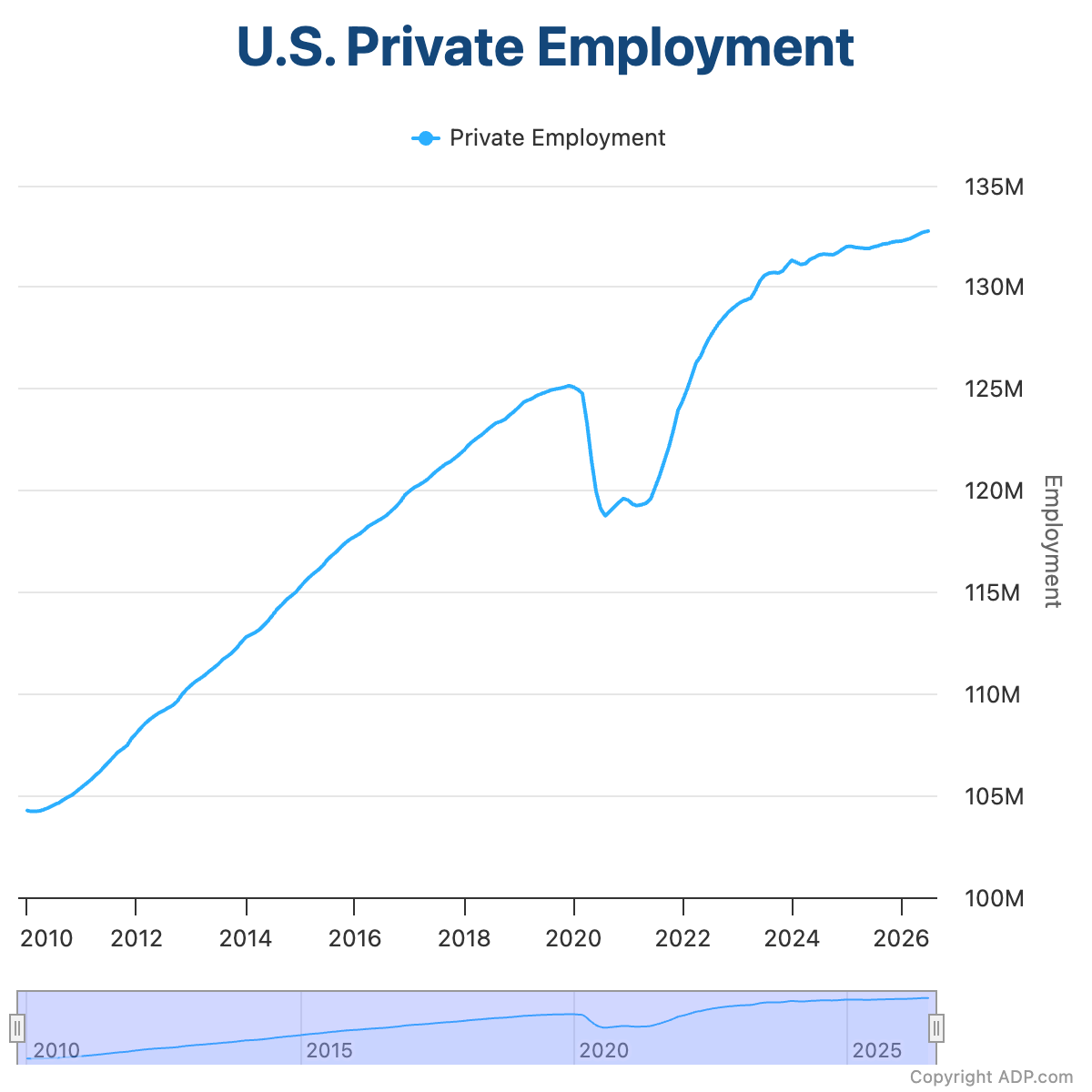
Private payroll growth slowed to 44,000, down from a revised 95,000 in June. Healthcare and education continued to drive hiring, while leisure and hospitality, transportation, utilities, and resource-related sectors shed jobs.
Source: ADP
Yet the more important takeaway may be what did not happen.
Wage growth remained elevated, and there was little evidence of widespread layoffs. Instead, firms appear increasingly reluctant to add headcount while continuing to retain workers already on payrolls. That is consistent with a "low-hire, low-fire" labor market rather than one entering recession.
S&P Global: Businesses Are Getting Busier
If ADP highlighted caution, S&P Global highlighted resilience.
July's Services PMI climbed further into expansion territory, with stronger production and new business inflows. Firms reported accelerating activity at the start of the third quarter, suggesting demand remains healthy despite higher borrowing costs and lingering tariff uncertainty.
The survey is broadly consistent with an economy that continues growing at a moderate pace rather than one heading toward contraction. Stronger business activity alongside weaker hiring may indicate improving productivity rather than collapsing demand.
ISM: Employment Readings Mixed
The ISM report adds another layer to the story.
The services sector experienced contraction in employment, while the key labor-related components continued to signal stability. After the employment index moved back into expansion at 51.2 in June, marking its first positive reading in four months, things took a turn for the worse in July. In the month that just went by, the employment index fell 3.8 points to 47.4.
However, manufacturing employment expanded for the first time in 33 months, with the corresponding index rising 3.1 points to 52.8 in July.
For payroll traders, the significance is straightforward.
Neither the S&P nor ISM surveys are consistent with a labor market falling off a cliff. Instead, they suggest companies remain busy enough to maintain staffing levels even as hiring slows.
The Big Theme: More Output, Fewer Workers
Put the three reports together and a common theme emerges.
- Hiring is slowing.
- Wage growth remains firm.
- Services activity is accelerating.
- Employment indicators remain mixed.
- Layoffs remain relatively contained.
That combination points toward an economy generating more output without generating many additional jobs. In other words, productivity may be doing more of the heavy lifting. The increasing adoption of artificial intelligence (AI) and automation, combined with a labor market that remains difficult to forecast, could be allowing businesses to meet demand without significantly expanding payrolls.
What Markets Want to See
Consensus expectations heading into Friday are roughly:
- Non-farm Payrolls: +88,000
- Unemployment Rate: 4.2%
- Average Hourly Earnings growth: around 0.3% month-over-month
A payroll figure near consensus would largely validate the "cooling but healthy" narrative currently embedded in markets.
Market & Rates Scenario Analysis (Post-NFP Release)
| NFP Numbers (Probabilities) | Fed Rate Outlook | Bond Market Reaction | Equity Market Reaction | US Dollar Reaction | |
|---|---|---|---|---|---|
| Base Case | 70K-110K payroll gains; 4.2% jobless rate; +0.3% AHE | Rate pause may continue | Yields move sideways | Mild upside likely; small-caps, cyclicals outperform | Flat to slightly weak |
| Hawkish Shock | >150K payroll gains; <4% jobless rate; +0.4% AHE | Raises odds of rate hikes, potentially as early as September | Yields spike sharply, a 10-15 bps increment in 2-year likely | Tech, high-multiple growth and interest-rate sensitive sectors take a hit | Surges |
| Dovish Outcome | <40K payroll gains; >4.3% jobless rate; unchanged AHE | Rate cuts back on the table | Yields drop significantly across the curve, leading to bond market rally | Initial reaction could be a scare sell-off, although the market may move back up on rate cut possibility | Weakens |
Bottom Line
ADP paints a picture of slower hiring. S&P Global and ISM paint a picture of businesses that remain busy and continue to add workers selectively. Together, they suggest the labor market is losing momentum but not breaking.
Friday's payroll report will determine whether July was simply another month of gradual cooling, or the first sign that the labor market is slowing faster than policymakers and investors expect.


