Diesel prices are near record levels even as crude oil remains below $100 a barrel, highlighting an increasingly important disconnect between the price of raw oil and the cost of refined products.
The U.S. national average diesel price reached $6.49 a gallon on September 21, according to GasBuddy data cited by petroleum analyst Patrick De Haan, after rising more than 30 cents in a week.
US Retail Diesel Prices
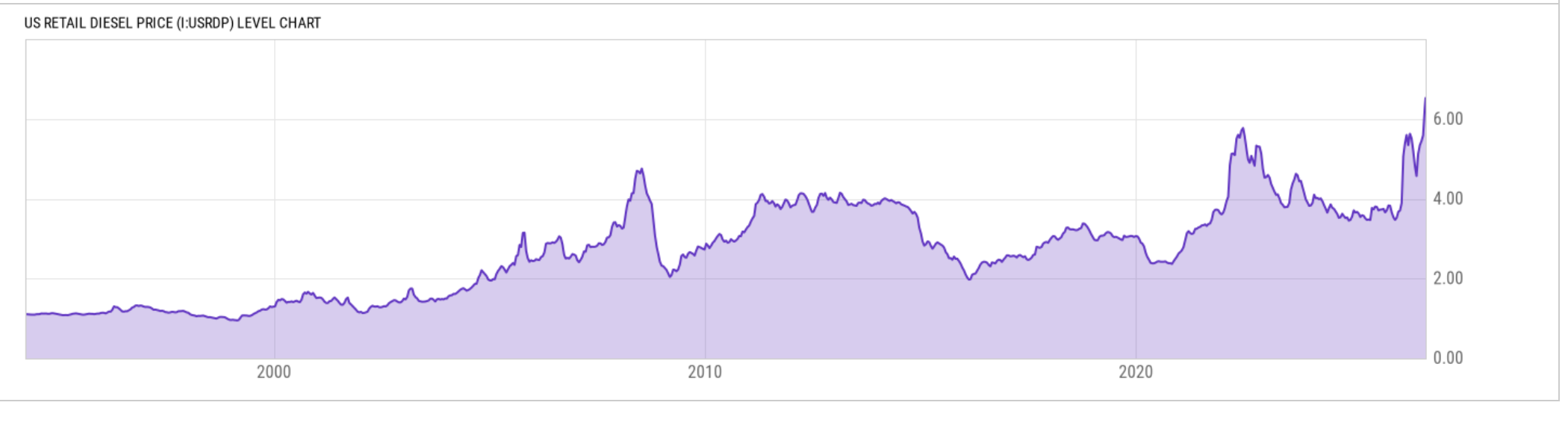
Source: Y Charts
Yet WTI and Brent crude have pulled back from their recent highs, leaving traders with an apparent contradiction: if crude is not at record levels, why is diesel so expensive?
The answer lies in a tightening global refined-product market rather than simply the price of crude.
Diesel Has Become the Bottleneck
A barrel of crude does not translate into an unlimited supply of diesel. Refineries produce a mix of gasoline, diesel and other petroleum products, and their ability to adjust that mix is constrained by refinery configuration, economics and available capacity.
That distinction has become critical as global diesel supplies have been hit by simultaneous disruptions.
The International Energy Agency (IEA) said as much as 3 million barrels per day of Middle Eastern refining capacity became unavailable following the escalation of the Middle East conflict, with 2.2 million bpd still offline through August. At the same time, Ukrainian attacks have disrupted Russian refineries, reducing one of the world's major sources of refined products.
Russia's refinery output fell sharply in June, while Moscow subsequently restricted diesel exports and began importing gasoline to protect domestic supplies.
The result is a shortage of exportable refined products even though crude itself is not facing an equivalent global supply deficit.
The Global Diesel Squeeze Is Pulling on US Supplies
The supply disruption has turned the U.S. into an increasingly important source of diesel for international buyers.
De Haan estimates that U.S. diesel exports reached a record of nearly 1.9 million barrels per day (bpd) this summer as buyers in Europe, Latin America and Turkey competed for available barrels.
That competition matters because U.S. diesel prices are ultimately connected to global rather than purely domestic supply and demand.
The U.S. remains a major distillate producer and has substantial refining capacity, but attractive export economics encourage refiners and traders to send barrels toward markets where diesel is in shorter supply and prices are higher.
That creates a feedback loop: global shortages lift export demand, stronger exports draw down U.S. inventories, and tighter domestic inventories reinforce the price signal.
Inventories Leave Little Room for Error
The inventory picture adds another layer of support to diesel prices.
EIA data for the week ending September 18 showed U.S. distillate inventories fell by 0.4 million barrels, but stocks remained about 12% below the five-year seasonal average.
That leaves the market more vulnerable to another refinery outage, shipping disruption or unexpected demand increase.
De Haan also noted that U.S. refineries have been operating at exceptionally high utilization rates, with some regions exceeding 100% because of refinery process gains.
High utilization is an important signal: refiners are already responding to strong margins and tight product availability by running hard. That limits the market's ability to generate additional supply quickly if another disruption occurs.
Why $95 Oil Does Not Mean Cheap Diesel
The crude-to-diesel relationship is therefore more complicated than simply converting the price of a barrel into the cost of a gallon.
At $95 a barrel, the crude input equivalent is roughly $2.26 per gallon before refining, transportation, taxes and other market components.
The unusually large gap between that crude value and the retail diesel price reflects the scarcity premium embedded in the refined product.
This is effectively a diesel crack-spread story. When diesel becomes scarce relative to crude, the value of the refined product can rise dramatically even without a comparable move in the underlying crude benchmark. A 3-2-1 crack spread is a standard refinery-margin measure that estimates the gross profit from turning 3 barrels of crude oil into 2 barrels of gasoline and 1 barrel of diesel/distillate.
3-2-1 Crack Spread
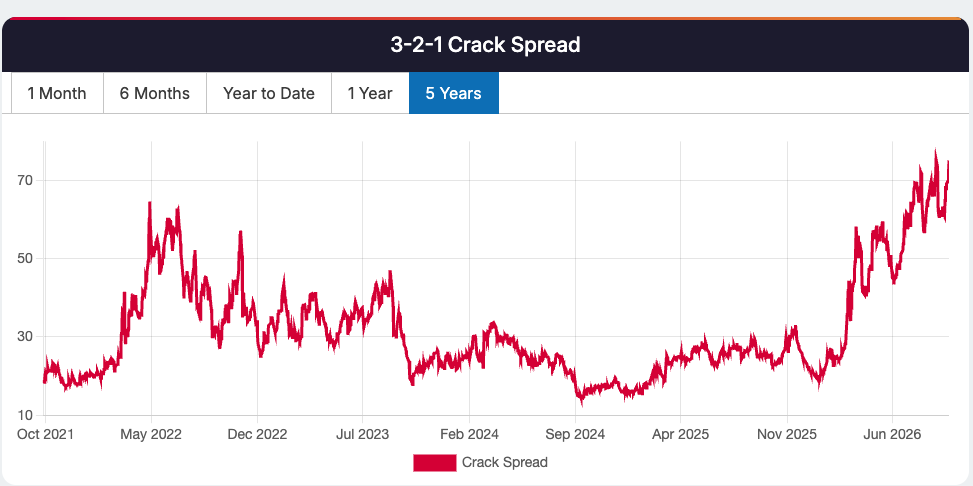
Source: RBN Energy
Refiners then have an incentive to maximize distillate production, while traders compete for available barrels.
The IEA said exports of refined products from Russia and the Middle East fell by nearly 75% year over year in August, underscoring the scale of the supply shock confronting the market.
Why 2008 Is a Poor Comparison
The current market also differs materially from 2008. In 2008, the major constraint was the price and availability of crude itself. Oil surged to around $147 a barrel as the global economy was still consuming large quantities of petroleum.
The present shock is more concentrated in refining and refined-product logistics.
Crude can therefore remain below $95 while diesel trades at historically elevated levels. The market does not need to experience a crude shortage for diesel to become scarce.
This distinction is particularly important for traders watching the oil complex. A decline in WTI or Brent does not automatically imply that diesel margins or distillate prices will follow lower.
Hormuz Adds a Critical Logistics Risk
The Strait of Hormuz is making the refined-product shortage more difficult to resolve.
Some of the world's newest and largest export refineries are located in the Persian Gulf. When shipping through Hormuz is restricted, those barrels cannot easily reach international buyers even when the underlying refining capacity exists.
That effectively creates a location-specific shortage.
The U.S. Gulf Coast can respond by exporting more diesel, but that also means American inventories can become increasingly exposed to global demand.
At the same time, moving surplus Gulf Coast diesel to U.S. regions that depend more heavily on imports can face logistical constraints.
The Jones Act waiver has helped facilitate additional shipments between U.S. ports, but its expiration would introduce another potential source of friction just as heating-oil demand increases.
The Next Test Is Diesel, Not Just Crude
For oil traders, the key signal may therefore shift from the outright price of crude toward the relationship between crude and refined products.
A further decline in WTI would not necessarily eliminate diesel's supply premium if Russian and Middle Eastern refining disruptions persist.
Conversely, a meaningful recovery in refinery operations, a reopening of Hormuz or a sustained increase in global refined-product exports could begin narrowing diesel margins even without a major move in crude.
For now, the market is telling a more specific story than simply "oil is expensive": crude is relatively constrained, but diesel is much more constrained.
That distinction explains why diesel can approach $6.50 a gallon while crude remains below $95, and why the next major catalyst for fuel prices may come from refinery availability, global product flows and shipping routes rather than crude production alone.