The Dow Jones Industrial Average dropped about 340 points on Thursday, roughly 0.6%, as a sharp fall in Walmart, a fresh climb in bond yields, and another leg higher in oil all pulled at the market at once.
The S&P 500 slipped around 0.3% and the Nasdaq Composite fell about 0.7%. For futures traders, that left the Dow contract (YM) giving back most of the relief it enjoyed just one day earlier.
It was a quick change in mood. On Wednesday, stocks had snapped a three-day losing streak after the Treasury Department stepped in to calm the bond market. By Thursday, that calm had already faded.
Walmart Takes the Shine off the Dow
The biggest single drag was Walmart. The stock fell roughly 8% after its results landed, and because Walmart is a member of the Dow, a move that size pulls the whole index lower on its own.
On the surface, the numbers were not a disaster. The problem was the details. Comparable sales that is, sales from stores open at least a year, which strips out the effect of new store openings rose 2.6% in the U.S. That came in under the 3.5% that analysts had been looking for.
Just as important, Walmart's guidance disappointed. "Guidance" is simply the company's own forecast for the months ahead, and management pointed to adjusted earnings of $0.62 to $0.64 a share for the current quarter, below the $0.68 Wall Street expected.
Management tried to strike a confident tone, with the company raising its full-year outlook and describing the business as stronger and more durable. But investors focused on the softer sales and the cautious quarterly forecast instead. One retail analyst summed up the worry: after a conservative outlook last quarter, a slightly better forecast this time may not be enough to win back confidence.
There is a bigger message buried in the report. Walmart said shoppers pulled back partly because of rising gas prices a direct link between the oil market and the American consumer. That is why the damage did not stop with Walmart.
Consumer staples was the weakest corner of the market, and other defensive names such as Costco felt the pressure too. When the country's largest retailer flags a more careful shopper, traders take it as a read on spending everywhere.
Yields Reverse, and the Bond Market's Relief Looks Fragile
The second weight on the Dow was the bond market. Yields had dropped on Wednesday after the Treasury said it would at least double its buybacks of 10-, 20- and 30-year debt over the coming months.
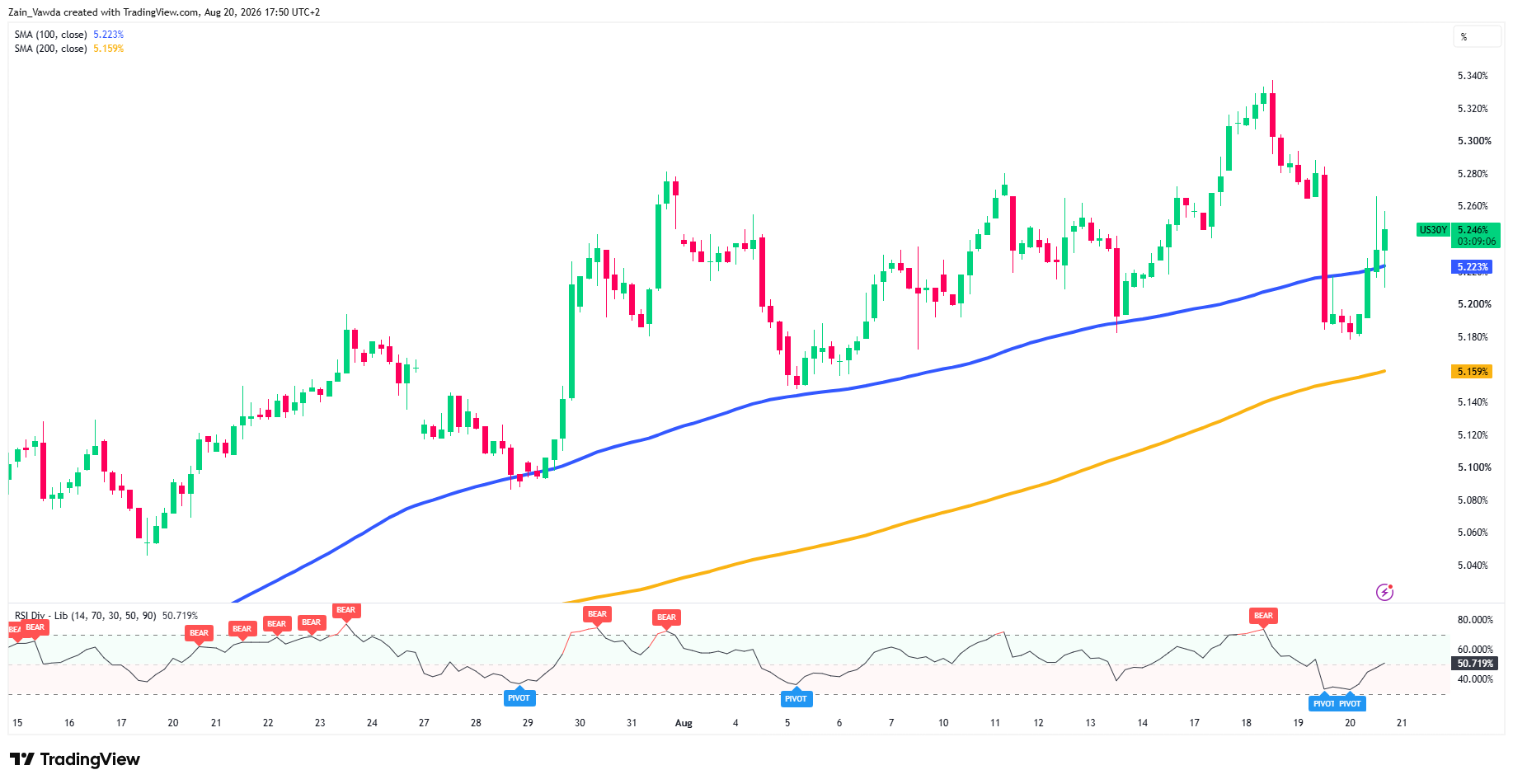
US 30Y Four-Hour Chart, August 20, 2026
Source: TradingView
A buyback is exactly what it sounds like: the government purchases its own bonds back, which supports their price and pushes yields down. That move offered a lifeline after the 30-year yield had spiked to its highest level in almost 20 years earlier in the week.
On Thursday, that relief unwound. The 10-year yield rose more than four basis points to around 4.70%, and the 30-year climbed to roughly 5.24%. (A basis point is one-hundredth of a percentage point, the standard unit traders use for small yield moves.) Higher yields make bonds more competitive with stocks and raise borrowing costs across the economy, so a rebound in yields tends to press on equities and it did.
Not everyone believes the calm can last. Michael Schumacher, former head of macro at Wells Fargo, told CNBC he remains "still negative" on bonds. His reasoning is structural rather than about any single headline: a large budget deficit that shows little sign of shrinking, and defense spending that is heading higher pressures he says were building even before the conflict with Iran, and have only intensified since.
If he is right, the buyback may buy time rather than fix the problem, and yields stay a threat to the Dow into month-end.
Oil Keeps Climbing as the Iran Standoff Escalates
The third pressure point was crude. West Texas Intermediate, the main U.S. oil benchmark, rose about 1% to trade above $87 a barrel, while Brent, the global benchmark, pushed above $93. The trigger was another sharp escalation in the U.S.-Iran standoff.
President Trump signaled a dramatic new economic campaign against Tehran, describing it in a social-media post as "Economic Warfare and Isolation on an unprecedented scale."
For the Dow, oil cuts both ways. It feeds the inflation story that has kept yields elevated, and as Walmart just reminded everyone it squeezes household budgets at the pump, which then shows up in weaker retail spending.
Dow Jones (YM) Technical Outlook
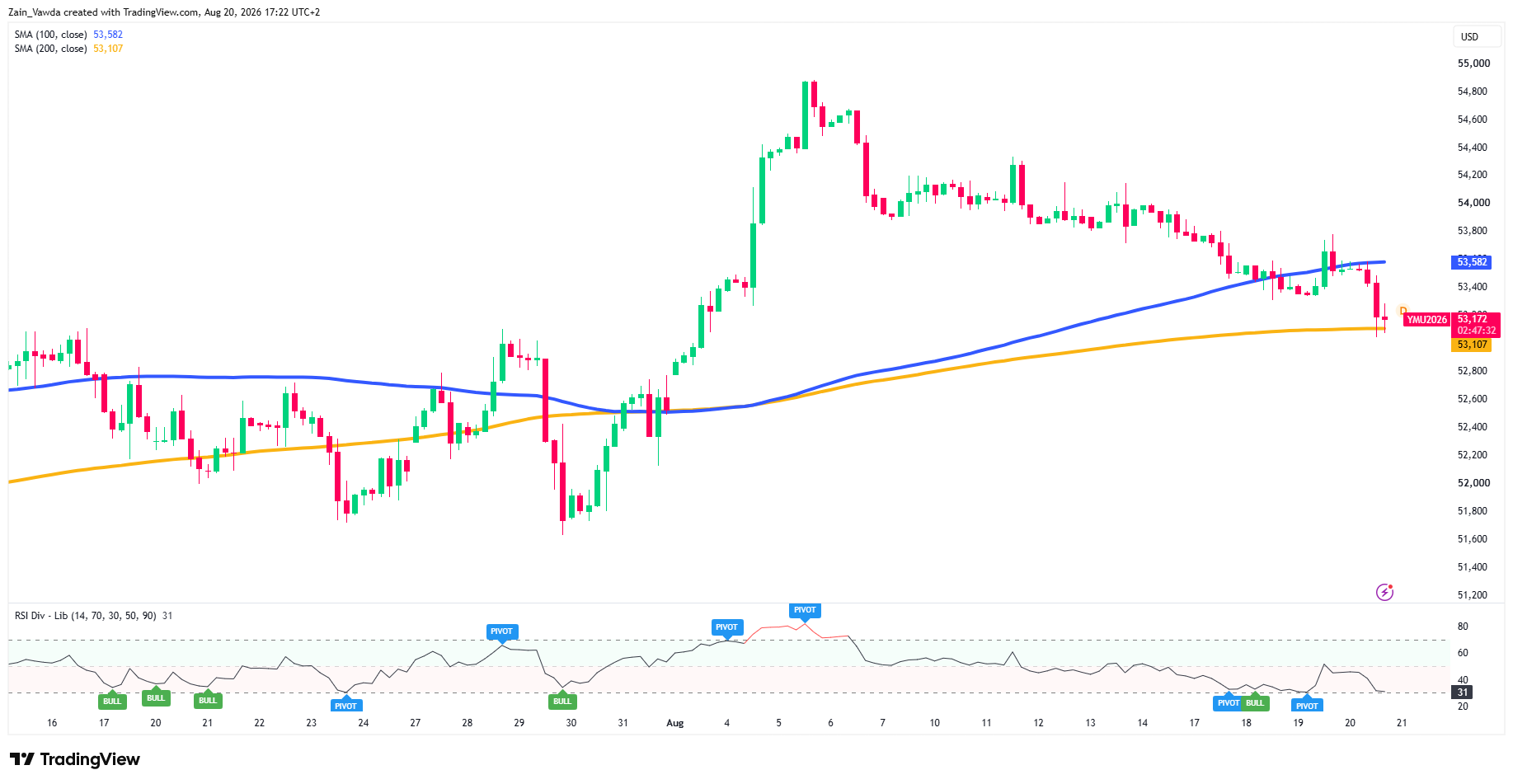
Price (53,172) is in a steep corrective pullback following its early-August peak near 54,900.
The contract recently lost the 100-period MA (53,582), converting it into overhead resistance. It is currently testing critical dynamic support at the 200-period MA (53,107).
RSI Momentum: The RSI stands at 31, touching oversold territory, which indicates selling pressure may be overextended near this support.
Dow Jones (YM) Four-Hour Chart, August 20, 2026
Source: TradingView
Key Technical Levels:
Support: 53,107 (200 SMA). A clean breakdown below opens the door toward the 52,400–52,600 demand zone.
Resistance: 53,582 (100 SMA). Reclaiming this level is necessary for buyers to reverse short-term bearish momentum.
The Outlook for the Rest of the Week
The immediate test comes Friday, with the release of the S&P Global flash purchasing managers' surveys (PMIs). These are early monthly readings on activity in manufacturing and services, where any number above 50 signals growth.
A soft set of numbers would feed worries about the consumer that Walmart just stirred up; a firm set would keep the inflation-and-higher-yields narrative alive. Either way, it is the last major data point before attention shifts to next week.
And next week is a heavy one. Nvidia reports on Wednesday, August 26, after the close, a result big enough to set the tone for the whole market, not just tech. Then comes the Jackson Hole symposium on August 27–29, where new Federal Reserve Chair Kevin Warsh delivers his first keynote in the role on Friday, August 28.
With the Fed still openly debating whether its next move could be a rate hike, Warsh's debut is the event that could decide the direction into September.
For YM, the picture into the weekend is one of a market that has slipped back from the record highs set earlier this month and is now leaning on the buyback story to hold its footing.
As long as yields keep drifting higher and oil keeps climbing, rallies are likely to be sold rather than chased. A steadier bond market and a friendly PMI print would give the bulls a reason to defend the recent range; another jump in the 30-year, or fresh escalation with Iran, would keep the pressure on.


