Forty-eight hours ago the tape had written its story: hostilities were pausing, the Strait of Hormuz was reopening, and crude was in freefall. Monday’s session buried oil futures (CL) 7.5% to $82.61 on the assumption the war premium was draining for good.
So the question that greets the desk on Fed morning is an uncomfortable one: was any of that real — or did the market simply pay up for a ceasefire that never actually arrived?
The Reversal: Was the De-Escalation Ever Real?
Overnight, U.S. Central Command said Iran’s Revolutionary Guard launched a surprise ballistic-missile attack on U.S. forces — all intercepted — while U.S. and Saudi forces struck Iran-aligned targets in eastern Iraq and Jordan brought down five missiles.
Crude answered immediately: WTI back to roughly $82 (+3.4–3.8%), Brent near $87 (+3.8–3.9%). But the harder detail sits beneath the headline — tanker traffic through Hormuz remains essentially halted, and Iran has rejected Oman’s 50-50 shipping proposal. If the chokepoint never truly reopened, was Monday’s collapse a genuine de-escalation, or a positioning flush now unwinding?
Add to that U.S. President Donald Trump's comments ahead of the U.S. session and oil is down around 6.8% at the time of writing.
President Trump signaled aggressive military action against Tehran during a Fox News interview, warning that "we'll be hitting Iran hard" in response to recent strikes on U.S. targets in Jordan. While indicating diplomatic channels remain open — remarking that he is "going to let them keep talking" for now—the President emphasized that upcoming U.S. strikes are imminent.
Demonstrating broader regional backing, Trump noted that ongoing military responses involving both U.S. and Saudi assets were closely coordinated with the Iraqi government.
The latest strikes and comments throw further shade on any swift de-escalation hopes in the Gulf.
Does the War Premium Reach the Fed’s Reaction Function?
Here the question sharpens. The Fed decides at 2:00 pm ET, presser at 2:30, and the base case is a fifth straight hold at 3.50–3.75%. But if the inflation impulse is re-widening rather than fading, does that thin the case for patience?
Markets already carry a fat hike tail — roughly a 30–35% probability of a 25bp hike, up from 31% yesterday and the mid-teens a week ago.
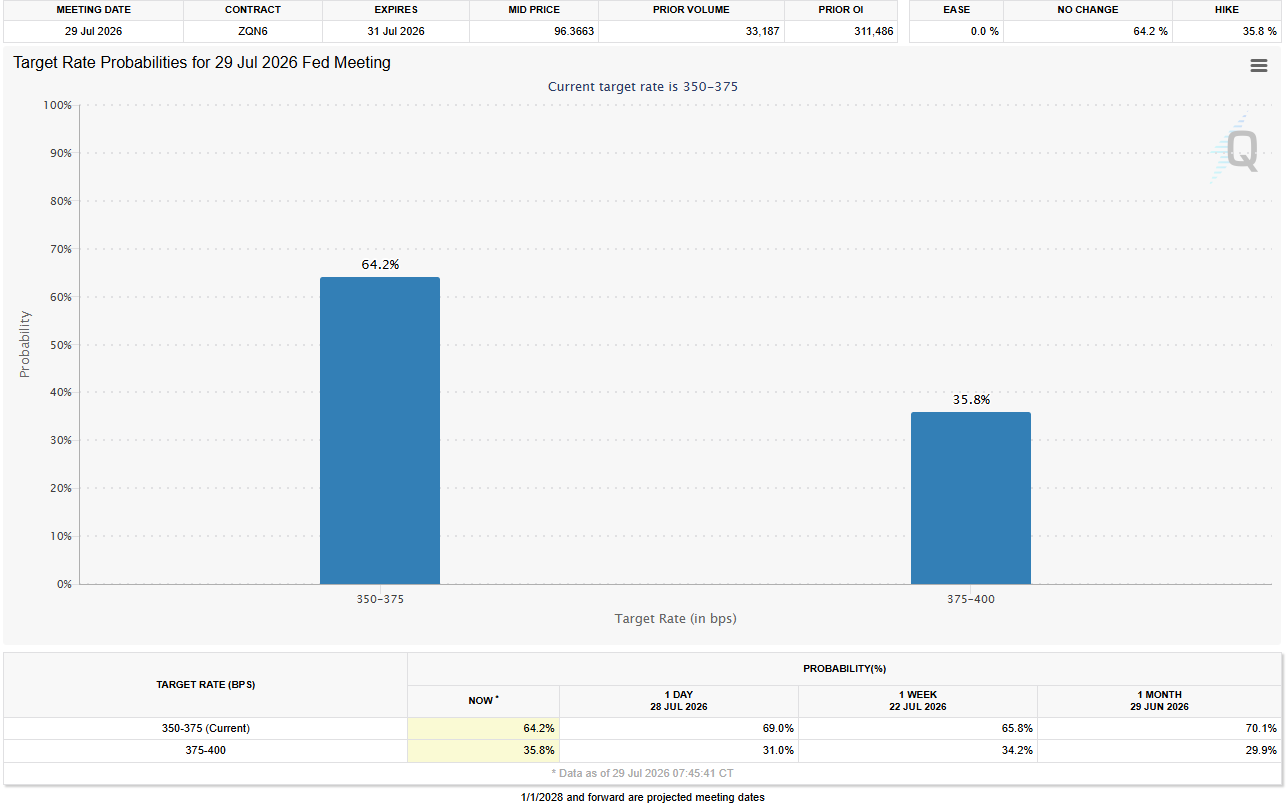
Source: CEM FedWatch
Citadel Securities has gone further, arguing the Fed should hike this week to defend Chair Kevin Warsh’s inflation-fighting credibility.
With no Summary of Economic Projections (SEP) and no dot plot at this meeting, does a guidance-stripped statement leave the 2:30 presser to carry all the volatility? And does a fresh oil spike hours before the decision make a hawkish tilt easier to justify — or is it simply too late in the cycle for one print to matter?
The Chain: Oil → Inflation Fear → Hawkish Tail → DXY → Gold
The recurring intermarket sequence is worth re-testing rather than assuming.
Higher crude feeds inflation expectations; a firmer hawkish tail lifts the dollar — DXY sits at a one-month high near 101.2–101.4 and a strong dollar caps gold, pinned near $4,021 despite risk-off and active central-bank buying. The 10-year, having rallied three sessions on the oil drop, has stalled around 4.61–4.64%.
The question for traders: is the dollar still the marginal price-setter here, or does a genuinely hawkish surprise finally break gold’s $4,000 floor and steepen the move? And with June PCE due Thursday (headline ~3.7%, core ~3.3%), does today’s oil bounce muddy a print that was supposed to show cooling?
Oil (CL) Technical Outlook
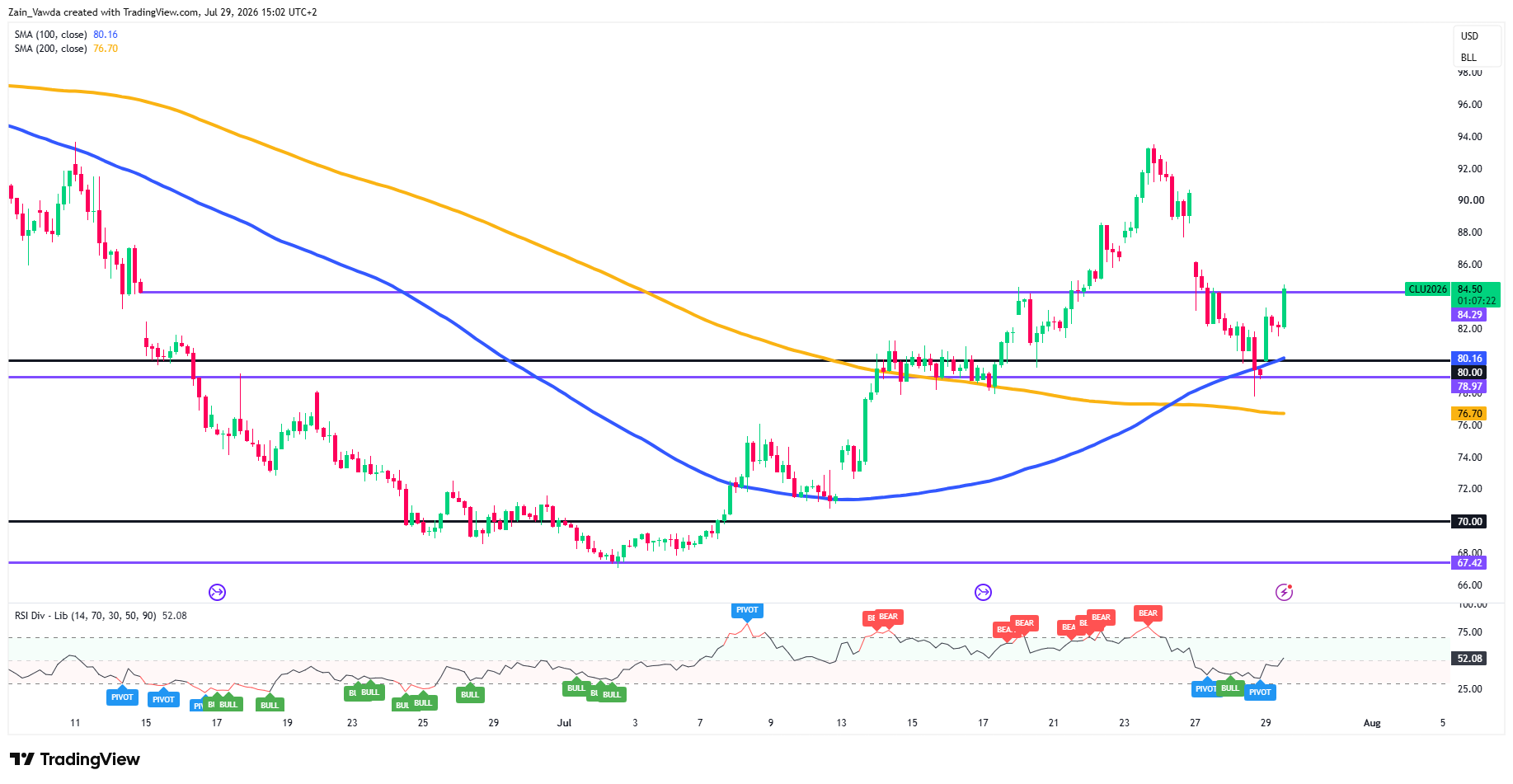
Oil/CL (H4) is pressing back into 84.50 resistance after a clean defense of the 80.00–80.16 confluence, where the round number, prior structure and the rising 100-MA converged to arrest the pullback.
Oil (CL) Four-Hour Chart, July 29, 2026
Source: TradingView
Price holds above both moving averages (100-MA 80.16 > 200-MA 76.70), keeping structure constructive, with the golden-cross alignment underpinning dips.
RSI has recovered off its pivot low back through the midline to 52.08 — momentum turning up rather than diverging.
A decisive H4 close above 84.50 re-opens the 90.00–94.00 swing highs; rejection here risks another rotation toward 80.00, with 76.70 the line that would neutralise the bullish bias. Bulls hold the initiative while 80.00 caps the downside.