
The 30-year Treasury yield just touched about 5.33%, its highest level since 2007. That number alone is a story, the last time it cost this much for the government to borrow for a generation, the first iPhone had barely gone on sale. But the more useful question for anyone trading ZB or ZN is why it happened, because the easy explanation doesn’t fit the facts.
US 30Y Yield Four-Hour Chart, August 18, 2026
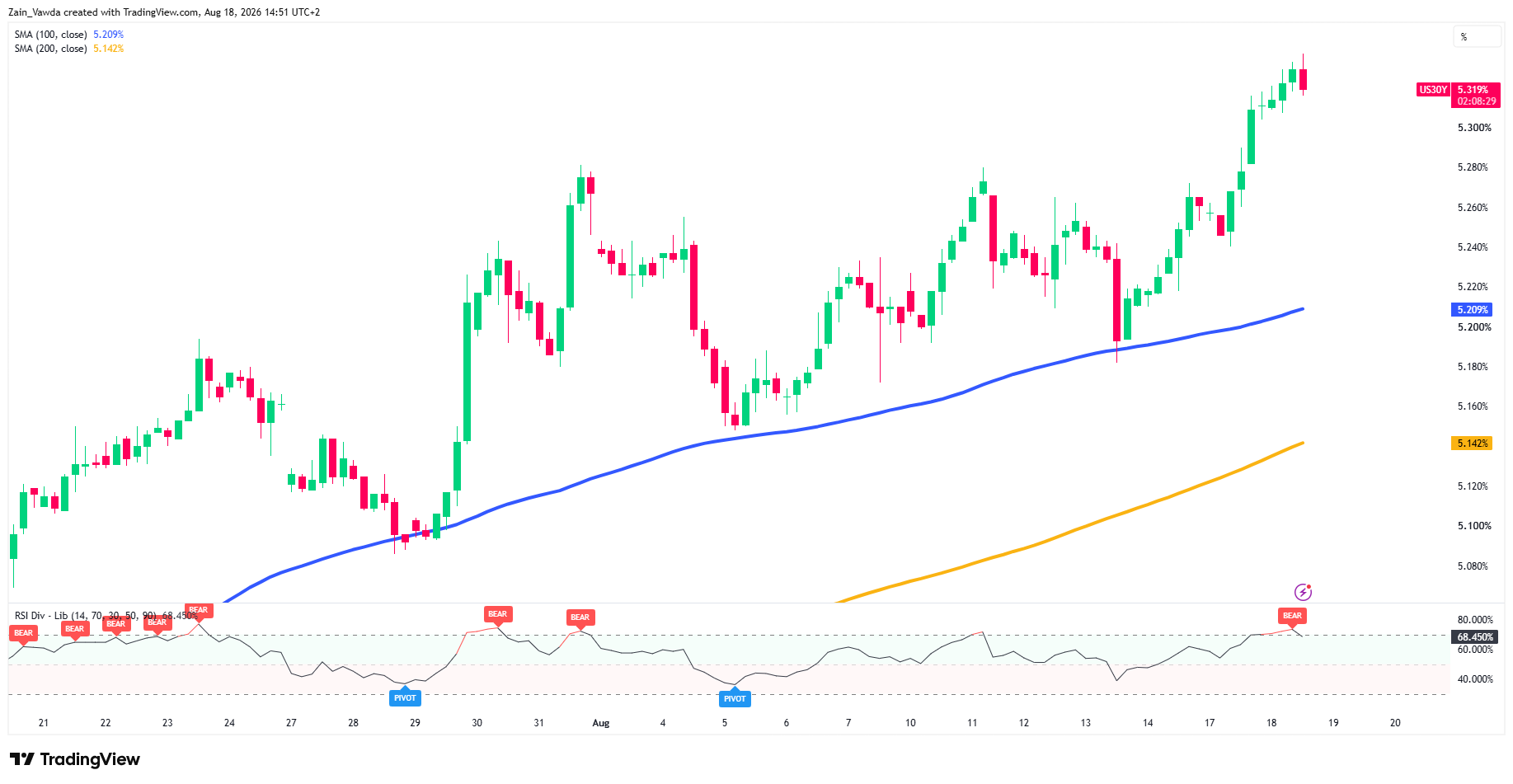
Source: TradingView
What Actually Moved
Look at the curve, not just the headline. The 30-year jumped, the 10-year (ZN) sits near 4.74%, but the 2-year (ZT) barely budged at around 4.18%. That gap is the whole point.
The 2-year tracks the Fed, and the Fed has held its target at 3.50–3.75% for five straight meetings. So the front of the curve, the part the Fed controls, hardly moved. The far end, the part the market controls, ran. When the long end rises while the short end stays put, the curve is getting steeper as it sells off. Traders call that a bear steepener.
Why This May Not be About the Fed
If the market had suddenly decided the Fed was about to hike, you’d see the short end lead, the 2-year would spike. It didn’t. And the recent data all argued the other way: July retail sales fell a surprise 0.6%, producer prices were flat, and inflation has cooled.
Every one of those readings normally pulls yields down. Long yields rose anyway. When soft data can’t drag the long end lower, the long end isn’t trading the Fed’s rate path at all.
Why it’s Mostly About the Deficit
The long end is pricing the things the Fed doesn’t control: how many bonds the government is selling, and how much extra yield buyers want for locking money up for 30 years, the “term premium.” Three pressures are stacking up.
The Congressional Budget Office raised its 2026 deficit estimate to about $2.1 trillion, $200 billion more than in February, more borrowing means more bonds, and sellers have to offer better prices (higher yields) to clear them.
AI companies have sold roughly $1.5 trillion of bonds this year to fund data centres, a flood of new supply competing for the same buyers. And demand is thinning: the UK, China and Japan all trimmed their Treasury holdings in June, while recent auctions cleared at the highest yields in decades (the 30-year at 5.216%, a 25-year peak).
As Barclays’ Anshul Pradhan put it, three soft releases argued for lower yields this month, yet “long end yields moved higher anyway.”
So Where Does the Fed Fit?
It’s not the driver, it’s the enabler. Normally, when growth softens, the market expects rate cuts and the long end falls. This time the Fed can’t play rescuer.
Inflation is still sticky, Chair Kevin Warsh has signalled no rush to cut, and three officials actually pushed for a hike at July’s meeting. With no cut on the way to cap yields, the deficit story runs unchecked.
Fundstrat’s Mark Newton thinks the long end could keep climbing toward 5.60–5.70% if the move keeps its pace.
The nearest scheduled catalyst is the minutes from the July meeting, out Wednesday at 2pm ET the record of that 9–3 hold, and how close the three dissenters came to forcing a hike. But keep the twist in mind: the minutes speak mainly to the front end, and the long end has been ignoring the front end all month.
A dovish read can even steepen the curve further if the market treats it as the Fed tolerating inflation. Here is how the three paths line up for ZB and the steepener.
The Setup into Wednesday’s Fed Minute
| Scenario | Fed Minutes Read | 30-Year/ZB | Steepener Readthrough |
|---|---|---|---|
| Bull | Dovish, dissents look isolated, Warsh firmly in control | Front end rallies; 30Y eases toward 5.20–5.25%, ZB bid | Curve pause, but an inflation-tolerant read can steepen anyway |
| Base | A split committee, as the 9–3 vote already showed | Long end keeps trading its own supply story; 30Y holds ~5.30% | NOB steepener grinds on; front end little changed |
| Bear | Hawkish, the three dissenters were close to winning | Long end pushes toward 5.60–5.70%; ZB breaks lower | Steepener extends; long end leads the move |
In Short
Profitable traders usually treat the long-end as a supply trade.
They lean on the curve, the NOB spread (buy the 10-year note, ZN; sell the 30-year bond, ZB) profits when the long end sells off harder than the front or they fade ZB rallies rather than buying the long bond outright.
Something to bear in mind heading into the Fed minutes release.


