
Updated with additional insights from the report, expanded analysis of the market reaction, and fresh commentary from analysts
U.S. job market contracted in July, the Bureau of Labor Statistics said in a report released Friday. Following the weak jobs numbers, financial markets repriced their interest-rate expectations.
Job Losses, Steep Downward Revisions Mar Labor Market Outlook
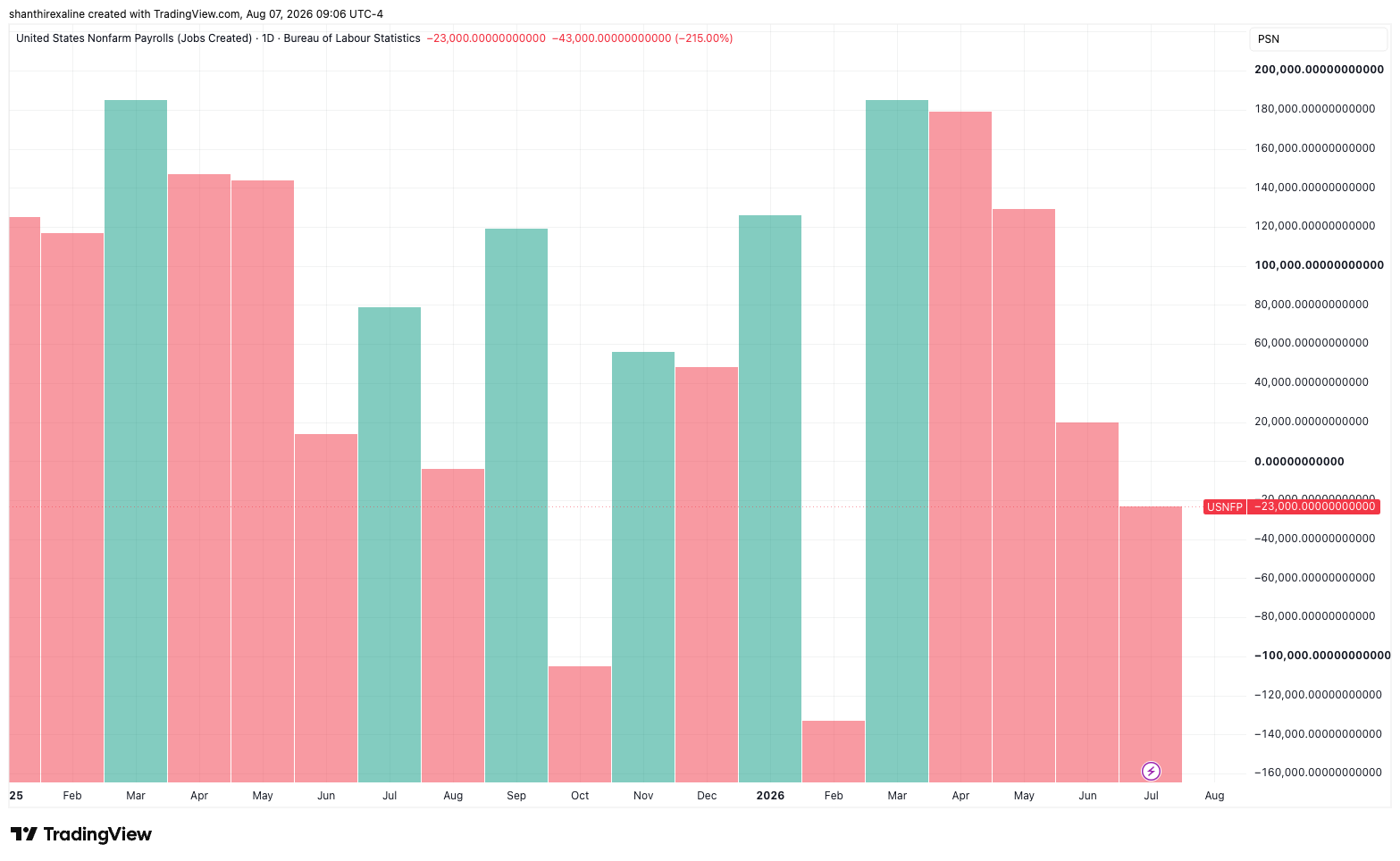
Non-farm payrolls fell by 23,000 in July versus economists' consensus estimate of an 85,000 increase. June job gains were downwardly revised to 20,000 from 57,000, and May gains were reduced to 63,000 from 129,000.
Job Market in the Red
Source: TradingView
Segment-wise analysis shows that private payrolls expanded by 30,000, while government payrolls fell by 53,000.
Source: TradingView
- Goods Producing sector: +25K Vs. +14K in June
- Manufacturing: +5K V. +11K
- Construction: +22K Vs. +5K
- Private Service-providing sector: +5K Vs, +16K in June
- Retail trade: -19.4K Vs. -3.7K
- Financial Activities: -14K Vs. -2K
- Temporary help Services: +3.4K Vs. +11K
- Healthcare & Social assistance: +22.6K Vs. 41K
Jobless Rate Ticks Down
The jobless rate edged down to 4.1%, vs. the expectations that it held steady at 4.2%. A broader measure of unemployment, called the U6 unemployment, remained steady at 7.9%. This metric takes into consideration unemployed, underemployed, discouraged and marginally attached workers.
Labor force participation was at 61.4%, down from 61.5% in June.
Inflation Cooling
Meanwhile, the average hourly earnings climbed at a monthly pace of 0.1% and by 3.2% year over year (YoY), down from the 0.3% and 3.4% increase, respectively, in June. (consensus: +0.3%, +3.5%)
Hard data released in the run-up to the jobs report relayed a mixed message. ADP's private payroll growth undershot expectations, and the quality of job gains was not anything that could evince confidence in the health of the labor market (It was mostly concentrated in the education and health services sector).
Weekly jobless claims were at sub-200K level for a third straight week, and the Challenger, Gray & Christmas report for July showed layoffs sinking more than a two-year low.
How Markets Reacted
Equity markets reacted positively to the data, with the Nasdaq E-mini futures (NQ) and E-mini S&P 500 futures (ES) trading solidly higher.
The post-NFP reaction in Nasdaq E-mini futures (NQ) is being accompanied by an extreme bearish divergence in trader positioning, even as prices rally more than 1%. MarketFrameworks' Positioning Edge data shows profitable traders are only 32% long (68% short), while unprofitable traders are 55% long, leaving profitable traders 23% more short than their less successful counterparts.
Notably, the gap widened after the jobs report, with the profitable cohort aggressively reducing long exposure as NQ pushed higher. This suggests experienced traders remain skeptical of the rally despite the market's dovish interpretation of the payrolls data and reduced rate-hike odds. The divergence points to a market driven more by short-term repricing of Fed expectations than by broad conviction, raising the risk that the post-NFP advance could face resistance if yields stabilize or incoming inflation data challenges the market's increasingly dovish outlook.
The U.S. dollar Index fell sharply, at 99.48 currently, down 0.45% from the previous session.
The bond market rallied, as yields fell sharply on tempered rate hike expectations. The 2-year T-note yield, which is closely related to the Fed funds target rate, slipped 6.6 points to 4.181%, and the 10 Year yield 5.1 bps to 4.619%.
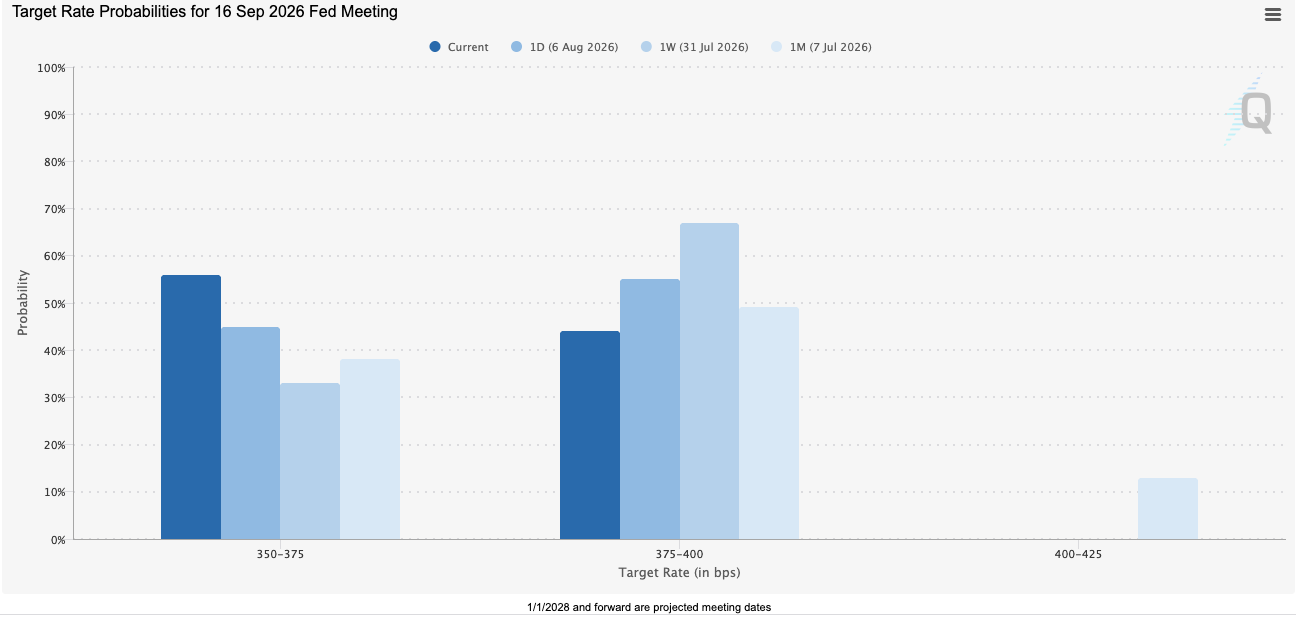
The market reaction reflected repricing in interest-rate markets, with the CME FedWatch Tool showing a 44.1% probability of a September rate hike, down from 55% on Thursday.
Source: CME
Economists Hold Mixed Rate View After Jobs Data
Analysts said the July employment report materially shifted the market narrative from one centered almost exclusively on inflation to one that also includes emerging labor-market risks. Chris Zaccarelli, Chief Investment Officer at Northlight Asset Management, called the report a "game changer," arguing that softer hiring reduces pressure on the Federal Reserve to raise rates and should keep policymakers on hold for at least one more meeting, barring an upside inflation surprise in next week's CPI report.
Bill Adams, Chief U.S. Economist at Fifth Third Commercial Bank, struck a more nuanced tone, noting that the headline payroll decline was heavily influenced by a drop in local government education employment that may reflect seasonal-adjustment distortions. While payroll growth has slowed markedly, Adams said the labor market remains relatively tight because labor-force participation continues to decline, particularly among older workers. As a result, he expects the Fed to look through the weak payrolls print and remain focused primarily on inflation ahead of its September policy decision.


